They're Taking The Peace

Back when I had transferred from the quantum research group to the security research group when I was working at a large corporate research lab (it employed some 4,000 people) I had to learn a smidgeon about risk analysis1. I never really did this in any systematic way - it was more a case of being decently aware of the general principles and techniques. I was more interested in the technical details of crypto at the time. The maths behind crypto is really lovely stuff.
When you’re looking at some crypto algorithm obviously one of the prime (if not the prime) considerations is whether or not it is ‘secure’. But what does ‘secure’ even mean? Turns out this is not an entirely trivial question.
All modern crypto algorithms2 are insecure - by which I mean given enough time and computational resource they can be broken. But that’s OK. Why? Because you design an algorithm so that there is not enough computational resource to be able to crack the crypto in anything like a reasonable time.
So modern proofs of security run something like this - the algorithm is considered to be secure against a specific attack (known plaintext, known ciphertext, etc) if it can be shown that a computer cannot ‘do better than guessing’ against it in polynomial time with a negligible probability3. I’ve been a touch loose even with the fancy sounding technical terms there - but each term, and the methodology of proof, are very well-defined.
In ‘risk’ terms you accept a tiny, tiny risk (in probabilistic terms) and the aim is to make that risk almost indistinguishable from zero when attacked by polynomial time computational resources.
The technical world is nice like that. You can, if you’re OK with all the arcane squiggleation, place nice limits and have considerable certainty about things. Real life; not so much.
When you’re dealing with people and society it all gets a lot messier. There are few (if any) ‘laws’ or ‘proofs’ in the same way as they exist within maths and the mathematical sciences. Some risks we are aware of (steaming great manslab pervs4 in the ladies loos, for example) - but they’re rarely discussed or analysed in any systematic way. On the ladies loo issue, if you’re a Terfy McTerf you’ll amplify the (perceived) risk and if you’re a BeKind™ Loon you’ll almost entirely downplay those risks.
Those risks, however, exist. What the argument is about is the level of risk.
Those risks for the ladies loos are not really systematically analysed because it’s bloody difficult to do so properly. I confess I don’t have much of an idea about how to do this in any fully rational way, short of pointing out the obvious from the existing crime stats and the differences therein between men and women (actual men and women and not their pretend versions).
In general, we accept some level of risk because trying to make everything 100% safe would, basically, cripple everything - not to mention turning us all into basket cases. We need look no further than the whole pathetic Covid Saga™ to see just how stultifying and horrific things became when ‘safetyism’ became the order of the day.
We accept a level of risk on the roads, for example, when limiting cars to 5mph would eliminate almost all of that risk. We don’t do that because the ‘cure’ would be worse than the ‘disease’.
One of the chief problems we face when confronting risk at a societal level is that human beings, generally, are really shit at assessing risk. Really shit. Part of this is that we’re not all that good at separating out the ‘local’ from the ‘global’. Global thinking (i.e a statistical analysis approach) is unnatural to us and we need to train ourselves to do it. Every Tom, Dickless, and Harry has a ‘lived experience’ though. This is why it’s so very common when making a global (statistical) point you get numpties piping up that they know examples of x, y, and z personally and so what you’re saying can’t be true.
It’s why when you quote stats at some woke-crippled mind they will invariably fire back with personal anecdote as if this is some rebuttal (or even relevant).
During Covid, for example, the risks to children were extremely low (essentially zero in terms of mortality). In fact, from the official data, you have to go quite some way up the age ranges before you start to hit a sufficient level of mortality risk to be seriously concerned. In practical terms, under the ‘standard’ model of infection, the most sensible course of action would have been to let people under the age of 70 (60 if you wanted to be extra cautious) just go about their business so that there existed considerable disease acquired immunity in the general population. This, under the standard model, would have slowed the spread massively more effectively than any lockdown.
Yet we acted, despite the ‘don’t kill granny’ campaigns, as if everyone was facing some horrendous risk - including children. The whole subsequent “cost/benefit” arguments that our ‘health’ peeps used to justify vaccinating kids were farcical in the extreme. The NNTV (the number needed to vaccinate) was in the region of having to vaccinate over 500,000 kids in order to prevent one death (and that assumes the vaccines were in any way suitably effective - which they weren’t).
Of course, there are a few problems with this ‘standard model’ because the mechanisms and properties of infection are not wholly understood. I think the model is right in broad brush terms, but there are quite a few experiments that don’t seem to obey this nice and simple pat standard model (some do5, some don’t).
At some point we all have to consider risk and attempt to form some view on it, whether or not we couch it those terms. The difficulty, and the source of so much conflict, centres on two (related) things; the level of risk and how much risk one is prepared to tolerate.
Much of our current discourse on immigration and the vexed issue of Islam and the behaviour of some Muslims is really about the level of risk we perceive.
If we take two extreme positions to suitably ‘bound’ the risk of Islam and Muslims we might categorize them as follows
Muslims present no threat to our way of life at all
Muslims present an extreme threat to our way of life
These are what we might call the boundaries of reality within which we must operate. There is, of course, a genuine spectrum of opinion within those extreme bounds, but where does the actual truth, the actual risk lie? And if we could even work that out on what basis and how, do we determine whether that risk is acceptable or unacceptable?
And, more to the point these days, are we even allowed to have the necessary conversations that would enable us to understand the risks more accurately?
In order to get some introduction to the potential risks let’s wind the clock back 10 years and take a trip to Cologne on New Year’s Eve. On that fateful night something happened that shocked German society to its core. Hundreds of women were sexually assaulted on the streets by, mostly, immigrant men. Men whom Germany had welcomed in as ‘refugees’.
The first thing to note is the profound shock. That, in itself, tells us something. It tells us that, up to that point, modern German society had not expected this kind of thing. Straight away that tells us something about the culture clash going on here.
The second thing to note is that whilst this behaviour would indeed be condemned by most (probably close to all) Islamic scholars, it still happened. These people came from societies, presumably imbued with Islamic values (given the regions they came from), and yet the culture that spawned them was not sufficient to moderate their behaviour in their new host country.
The fact that this event was so shocking to Germans at the time tells you much about the difference between those two cultures and the respective effectiveness of the societal constraints and mores.
Immediately, upon talking about this, the woke-crippled mind will leap to the “not all” defence. It’s only a tiny minority of immigrants who would do such a thing, they would say. Yes, that’s probably true. And yes within German society there will be predatory and disgusting men, as there are in any society. But what, do you think, would be the probability of a bunch of German nationals acting en masse in this fashion? The shock this event caused tells you the answer; that probability is pretty much indistinguishable from zero. It’s so small that such an event, a mass sexual assault by roving gangs of German nationals has never happened before (or at least not within living memory - maybe in the distant historical past such things were more commonplace?). This is why it caused so much shock.
This event, the mass sexual assault of German women, was entirely preventable. Had Germany not imported such people this would never have happened and Germany would still not have witnessed anything like it in the subsequent decade and for the foreseeable future.
This is an example of a potential risk faced when importing people from entirely different cultures - cultures that do not share the same fundamental values or constraints. It may only be a tiny minority of scumbags who would do such a thing, but you’ve effectively elevated the risk of such an event by orders of magnitude6.
So, even though most immigrants will not be vile degenerate scumbags like those in Cologne on New Year’s Eve, what’s happened here is that you’ve started with a certain risk pre-immigration (tiny, tiny, never happened before sort of risk) to a non-negligible risk post-immigration (still small but nowhere near as small as it was).
If all of this reminds you of the difference between relative risk and absolute risk that we saw in relation to the Covid ‘vaccines’ then it should - because it’s exactly the same kind of analysis. You could think of deportation (or not letting them in in the first place) as being equivalent to vaccination (with an effective vaccine unlike the ‘vaccine’ for Covid).
Here’s a ‘meme’ I produced to illustrate the difference between relative and absolute risk in the context of effectiveness of the Covid vaccine and the small absolute risk most people under 70 faced from Covid
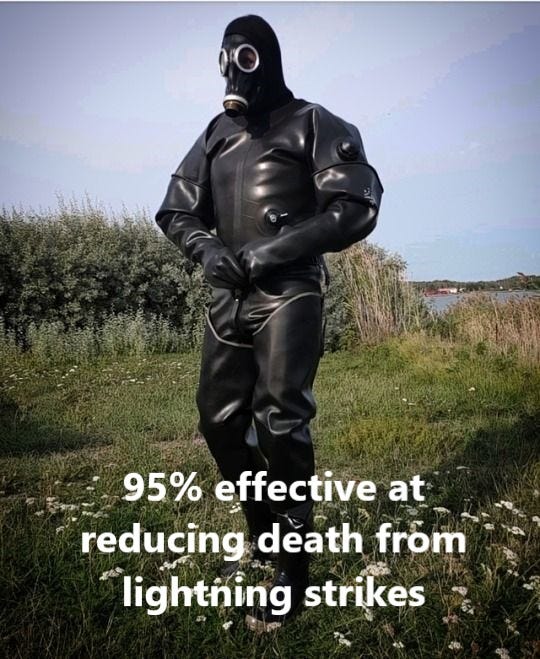
OK - so we accept that the relative risk in the case of rapey immigrants has risen substantially, but because it really is only a minority of immigrants who are rapey bastards who should have their nads removed, the absolute risk is still small.
And now comes the difficult part. What should be done about that? I think most of us would say that even though the absolute risk is still small it’s most definitely not OK. It will be for many (myself included), an unacceptable risk.
Which brings us to the other element of a risk analysis - just because an event is really rare does not mean it can be ignored if the consequences of that event occurring are severe. Rarity and consequence are the two main factors to consider. A nuclear accident may be extremely rare, but you definitely don’t want one of those happening - and so you put in a considerable amount of effort to make sure it doesn’t, because the consequences are so damaging.
One might also ignore (or accept) a certain level of risk, even with potentially serious outcomes, if the benefits can be said to outweigh any negative outcome. Allowing cars to drive on highways at reasonably high speeds would be an example here. You crash a car at 70mph the chances are you’re not walking away from that alive and yet we still think this is an acceptable ‘price’ to pay for society to be able to function reasonably. We know how to reduce that risk to almost zero (limit cars to 5mph, for example) but the costs in doing so would outweigh the benefit.
So here’s the nasty little question; does the benefit of bringing in a whole lot of refugees/immigrants from different cultures outweigh some of the negative consequences (like mass sexual assault)?
That would depend on what the benefit of bringing in those refugees is in the first place. I’m a bit stumped on that one - perhaps some of you could enlighten me on that score. It would have to be a fairly substantial benefit to outweigh the trauma suffered by hundreds of women on that night, don’t you think?
Maybe there were thousands of doctors, scientists and engineers imported who have gone on to save lives or make life-saving discoveries or produced new medical technologies? Maybe on balance the lives saved outweigh the horror and trauma suffered by those women on New Year’s Eve?
Yeah, right.
Sorry to couch all of this in such unpleasant terms - as if we can ever weigh up the suffered trauma against ‘lives saved’ like this. I’m putting it in these bleak coldly ‘rational’ terms to drive home a point.
I’ve picked the Cologne case because the standard argument of the woke-crippled mind is to say nationals rape and sexually assault people too (often couched in terms of race by saying ‘white people do it too’) and yet the Cologne case represents a kind of behaviour that was essentially completely unthinkable - until the immigrants arrived.
We could pick Sweden which has gone in the space of a handful of years from being one of the safest and most awesome places to be to one of the most dangerous places (in parts) on the planet. Think this would have happened without the benefit of all of that cultural enrichment they foolishly brought in? Not a chance.
Had they said nej to all those immigrants do we really believe that (parts of) Sweden would be in such a parlous state now?
Again we pose the nasty question; has there been a net benefit to Sweden as a result of their immigration policy?
Most of the analyses I’ve seen suggest that there’s a stark difference in net economic benefit between immigrants from a place within set X and immigrants from a place within set Y. I’ll leave you to figure out the kind of places sets X and Y represent. You won’t be surprised at the answer.
Immigrants from countries in set X : net economic gain - the host country is better off
Immigrants from countries in set Y : net economic loss - the host country is poorer
The net economic loss comes about because the host countries operate generous welfare and benefit systems for which people from countries in set Y qualify. If you wanted to balance the books, so to speak, you’d have to ensure that you were bringing in enough people from places in set X to counteract the loss you incur from bringing in people from set Y.
But economic net gains/losses are not the only relevant factor here, as the ladies in Cologne discovered. We could also phrase things in terms of a net gain/loss to your culture - a much harder metric to quantify, but important nevertheless. It certainly isn’t standard Swedish culture (or hasn’t been until very recently) to go around lobbing hand grenades about, for example.
I would suggest that if you do look at the countries from sets X and sets Y you could also do the following kind of classification
Immigrants from countries in set X : enjoy and respect the host culture
Immigrants from countries in set Y : a sizeable chunk of this group who are really quite keen to change the host culture
Multiculturism is the fancy buzzword that gets joyously sprinkled like confetti at a wedding by the woke-crippled mind. In practice this is something that is expected/enforced on the host ‘natives’ but not so much expected/enforced on the incomers. It’s decidedly not OK for the host ‘natives’ to criticize the culture of incomers (for example, the ridiculous attempts to criminalize ‘Islamophobia’) whereas they essentially get a free pass to bash the host culture.
But I think we’re all exhausted at pointing out the double standards of the woke-crippled mind; there have been far too many examples of their two-tier nature on display over the years.
We’ve all, by now, seen the very many examples of those who originate from Islamic cultures loudly proclaiming their desire to ‘take over’ and turn their host country into something different. Just recently in Times Square we had
Can you imagine a whole bunch of people from a non-Muslim background living in another country doing this kind of thing? What do you think might happen to, say, the Christian ex-pats working in Saudi if they staged this kind of public demonstration of criticism and intent?
Another recent example in the UK was discussed by Carl Benjamin on his Akkad Daily channel. His analysis (14m 6s) is interesting
Whether or not you agree with his assessments here he did make an important observation. He stated that the Muslims here originate from what is essentially a monoculture. I don’t know to what extent he’s right in that assessment, but Islamic conquest and colonisation, lets face it, is not exactly a prime example of ‘multiculturism’ in action is it? In general, historically, Islam has rather tended to wipe out any remnants of indigenous culture. We’ve done the same kind of thing too in the past.
There’s a real ideological conflict going on here - and you can see it very clearly in this video. Note also how the magic words of woke dominance are exploited. They so very obviously expected the magic words of ‘hate speech’ to get this WPC on their side - and let’s not pretend that it wouldn’t have worked for another police officer because we’ve seen how the UK police deal with ‘hate’ issues - but this WPC bucked the trend and held firm.
We see a steady drip, drip (a flood?) of these kinds of incidents - all the while being told that Islam poses no threat whatsoever to the British way of life. The weaselly woke words don’t properly match up to the evidence of our own eyes. We’ve seen this in the claims that Islam is the religion of peace. It’s usually stated with ‘the’ rather than with an ‘a’ - which is interesting.
The problem here is that when we look around the world at the behaviour of those who profess to follow Islam we see anything but ‘peace’. Since the start of the new millennium there have been some 50,000 terror attacks (mostly in Muslim countries, it has to be said) carried out by Muslims globally. I’ve chosen a conservative number of 50,000 here; some reports put this figure considerably higher.
There have been roughly 9,125 days since the start of the new millennium so that’s a decent record of over 5 terror attacks, per day, on average. Nice going for a religion of peace don’t you think? In this case there’s no comparable equivalent - there’s no “white people do it too” kind of argument to be had here because Islamic terror stands out like a VAERS signal with respect to those ‘vaccines’. There’s no other religion quite like it.
Here’s what a ‘safety signal’ looks like from the UK’s data on vaccines (the Yellow Card reporting system)
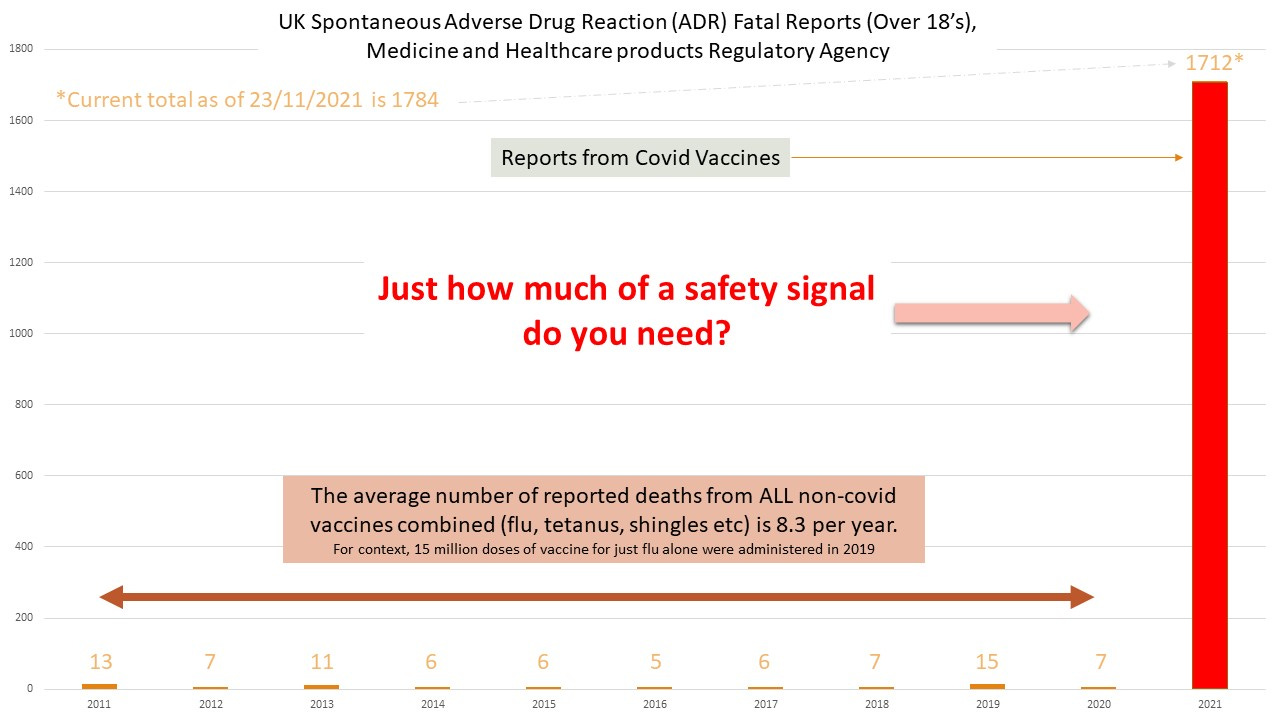
If you charted Muslim terror attacks against all other religious terror attacks combined it would look eerily like this chart.
This is a serious problem (obviously) even though we could also say that the majority of Muslims are not at all like this. That’s not the real issue. The issue is whether the risks of allowing sufficient of the non-peaceful variety minority Muslim into your country are too great.
And that just on the extreme violence metric. There are other metrics we could adopt too. How many other religions would kill people, and think it was right to do so, when their main prophet guy is ‘insulted’? This is not exactly a ‘fringe’ view within the Muslim community - many believe that insult should carry serious consequences, up to and including death.
Is that tolerable? Is that consistent with ‘our’ values?
In terms of our values we would think such a call to kill someone for insult is the behaviour of a spoiled child and not to be tolerated. No other religion seems to have these kinds of hissy fits on a routine basis. And what kind of religion is it that would seek to severely punish those who, freely, choose to leave that religion? There are plenty of examples of Muslim clerics defending the death penalty for apostacy. We have to ask ourselves just what kind of religion is this?
We end up in “no true Scotsman” territory with many of these discussions. Islam in the media is almost always presented in its most benign form - and yet the evidence, globally, is that the non-benign form of Islam is far from being a ‘fringe’ thing.
Are the risks presented by the non-benign forms of Islam too great?
Many would say so - but how on earth do we actually deal with all of this? I don’t have any good answer to that question, unfortunately. I don’t, personally, want to see some mass deportation campaign targeting Muslims. I know quite a few Muslims - have had some really in-depth conversations with them regarding their religion - and I really like most of the Muslims I’ve interacted with.
But I also can’t ignore the threat posed by what we might term non-benign Islam - people who most definitely are not of the live and let live mindset. Can we really afford to wait for some ‘Islamic Reformation’ when the immature spoiled child variant of Islam gets weeded out by the majority of other grown-up Muslims?
There are many considerations - not all cast-iron and objective - when building a system designed to secure something. You need to assess the level of likely threat, the damage caused should a breach occur, the costs of implementing any solution vs the likely losses and so on. Losses may not be couched in purely economic terms either. For example, the potential reputational loss to a company is a difficult thing to predict and analyse
The only algorithm to offer perfect security is the one-time pad. This cannot, in principle, be broken if implemented correctly. Implementing it correctly, however, is something of a bugger. It’s an extremely simple algorithm - just the bitwise XOR of the message bits with the key bits. The security rests entirely on the secrecy of the key which needs to be (a) as long as the message (b) a random bit string and (c) used only once
This is one of the main reasons for all the hype surrounding quantum computation. Quantum computers offer the possibility of shifting complexity classes and solving problems that are thought to be NP-hard (not capable of resolution within polynomial time, essentially) into ones that can be solved in polynomial time. This is possible for a very specific and limited range of problems (essentially those that can make use of the ‘fast Fourier transform’ structure of QM)
I’m talking about the autogynephiliac wing of the Trans Party here. Although I don’t really subscribe to the ‘true trans’ way of looking at this I think the risk to women (in the context of loos) from those we might want to describe as ‘true trans’ is lower than the risk from the AGP wing. You get what I mean, I’m sure, even though many of you would take issue with the terminology here. Whether the risk from ‘true trans’ is still unacceptably higher than the risk from women to other women in the same context is a contentious point
A while back I was out trying to get some bird photo shots at a place that kept some fairly unusual (for the UK) water birds. Talking to the guy there, he told me about the catastrophic effect bird flu had had on the local bird populations - and the loss of thousands and thousands of pounds worth of stock. Previously healthy populations were decimated. The whole ‘terrain’ theory approach and the rejection of viral infection adopted by some doesn’t really explain the spread and dynamics of the significant impact in very short timescales this disease had. Something ripped through those populations in short order and turned previously healthy birds sick - very sick indeed
What would you assess the risk probability of such an event to be before mass immigration? I would suggest extremely low. After immigration that probability is, clearly, as non-negligible as it was before. In math terms, then, even though we might be dealing with low risk levels for both pre and post immigration, the comparative level of risk differs by orders of magnitude
I answer the “not all” argument with this anecdote:
My grandson got swarmed and stung by yellowjackets that had nested near the front porch. Not all the yellowjackets stung him, but I decided it was best to remove the nest due to the difficulty of distinguishing the stingy ones from the non-stingy ones. Observing which ones would sting and which not was too costly an exercise so they all had to go: They were incompatible with the household residents.
Here in the US there are very, very many gun owners. We hear all the time, from the same people who oppose removing illegal aliens with the “not all” argument that, because some people who possess guns use them to cause harm, nobody should have guns. Their “not all” argument disappears into thin air, their hypocrisy being ample demonstration of their insincerity.
For my part, in terms of risk evaluation, whether manufactured flu or rapey immigrants, I prefer not to have a government assume authority over me. If I want to catch flu and die that is my prerogative. When the British people have told the government over and over again that they object to mass immigration, they should damn well do as they are instructed by the people that pay their wages. They are out of control tyrants.