Religious Appropriation and Misappropriation

I’ve wanted to write about religion for a while. I have literally no idea why anyone would be interested in my ramblings on the topic, but write I must. If you are religious and easily offended then maybe it would be best to look away now, because I’m going to be relatively scathing about certain beliefs.
For some context, I was brought up as a Catholic and went to Catholic schools. The first one run by nuns, the second by lay (non-ordained) brothers (De La Salle). I can’t remember which flavour of nun was responsible for my primary school years. Although in later years I have come to reject their beliefs, I have a great deal of affection for them. They were good peeps. So, to the La Sallian brothers and the nuns of unspecified flavour - my thanks and respect.
Around the age of 13 I started to question what I was being told about it all. I read a lot and tried to figure it all out. I stopped being interested in it all around the age of 30 or so, I suppose. Primarily, I was interested in the big Abrahamic 3 with a side helping of Buddha.
At the age of 16 I wrote to the Pope asking to be excommunicated. I was a bit pissed off at the time by my baptism; something I’d had no say in.
With only a bit of reading it quickly became apparent that the picture of Jesus and Judaism that I had been taught was a pile of horseshit. My favourite books on this relationship were written by Geza Vermes and E.P. Sanders. Some of them are these
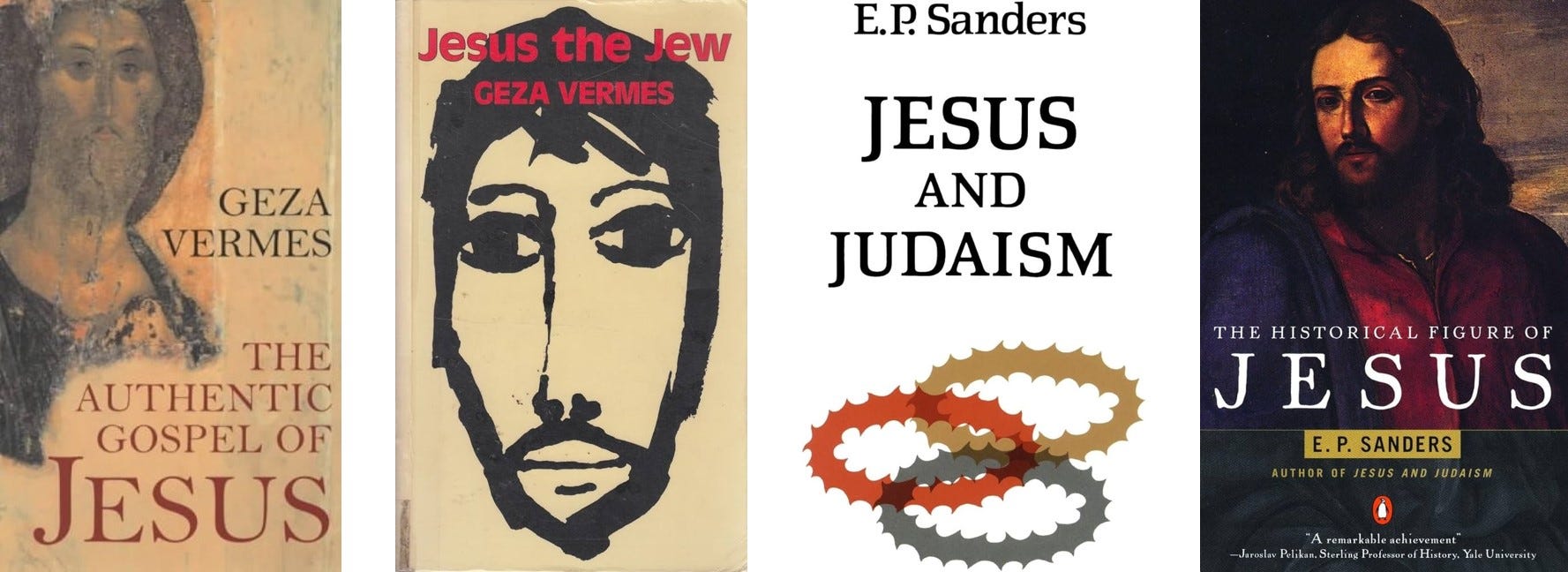
I built up a reasonable small library, most of which I donated to the local charity shop some years ago. In all likelihood they’re still there as they are somewhat niche, I guess.
I also had more than a few books on Islam and 3 different English translations of the Quran. I had been trying to find a translation in English that matched, or even partially captured, the claimed power and beauty of it in Arabic. I decided to stop at 3 because they were, let’s just say, not a fun read.
Although we hadn’t appropriated the word appropriate at the time, I came to view Christianity as a kind of appropriation of Judaism, and Islam as an appropriation of them both.
Jesus, or Joshua to use his more correct Anglicized name1, really should be understood as a Jew within the context of first century Judaism, in my view. He was clearly heavily influenced by the the great rabbi Hillel’s teaching and most of Josh’s arguments with others depicted in the New Testament are not against Judaism, but better understood as a conflict between two different schools of thought within Judaism; the schools of Hillel and Shammai.
I do not believe, at all, that he was trying to establish a new ‘religion’, or that he thought of himself as a divine being (the literal Son of God in the sense that Christians mean).
I always had a serious problem with those who told me that I would be “going to Hell” for the mere crime of disbelief. My problem wasn’t with them, as such, but at what this said about the God they believed in. What kind of God was it who could condemn someone to an eternity of cruel suffering for simply having a different viewpoint? Is God woke or something?
The God they talked about seemed like a total psychopath. And somewhat narcissistic to boot.
If God is really like this (which I don’t for one minute believe, should such a cosmic entity even exist) then we all ought to be absolutely terrified at what’s in store. We’re living in a universe run by a freakin’ psychopath are not the most comforting words one will ever hear.
Which leads me on to the next ‘big thing’ that I cottoned on to quite early on; we only ever talk about ideas of God. Religious people think the idea of God they have in their mind is the correct one. Furthermore, with what can only be described as nuclear levels of hubris, some of them claim to speak for God.
The arrogance and hubris of these kinds of religious folk is truly breath-taking.
Which leads us on to the next thing; upon what basis do they make the claim to ‘know’ what God is like, or to speak for God?
Invariably, this is because some long-dead bod told them what God is ‘like’, or what God ‘said’. If enough people are persuaded by these holy bods claiming to be in possession of some divine direct hotline, then it might get written down and added to over the years. Over time, more holy bods have a chat with His Almightiness and pass on the message, and some kind of Holy Scripture is built up.
One must choose which of these holy bods with God’s mobile number to believe in because, depending on where you’re born, you’ll tend to think one set of holy bods makes more sense than another set of holy bods.
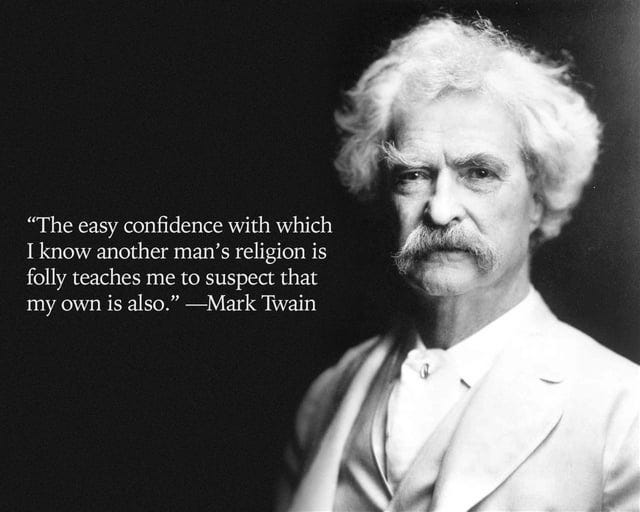
Which is a long-winded way of referencing Mark Twain’s glorious quote on religion
So, you end up with a book, of sorts, which people say is “God’s word”.
I’m not all that familiar with Roman, Greek, or Norse mythologies, but I think it’s a bit different. What you tend to have there is a collection of stories about various Gods who behave like humans and drink lots of wine and have sex with horses. That sort of thing.
Nothing quite as pompous sounding as “thou shalt not covet thy neighbour’s wife” is mentioned, and particularly not when you’ve just given birth to an 8-legged horse as a result of your equine coupling2.
All ribaldry and snark aside, I’ve found it very difficult throughout my life to make any convincing rational argument for the existence of any kind of deity. When viewed through a rational lens, all religions look decidedly suspect.
But when it comes to feelings, emotions, and what we might call a sense of spirituality, it’s a different ballgame. Here we enter the realm of faith and the picture derived from strict rational materialism doesn’t look so appealing.
The rational part of me can snark away and talk about prophets with God on speed dial; the more ‘spiritual’ side of me thinks some of the stuff I’ve read in these ‘holy’ books makes a lot of sense.
Not that this is an experiment that could be undertaken since religious ideas have so permeated everything else, but suppose we could raise our kids completely without any influence of religion of any kind. At the age of 18 we sit them down and give them the various holy writings of the world’s religions. Which one would they opt for, if any?
Would they find all of them equally silly, or would one stand out amongst them?
Another question, also unanswerable, which is along similar lines might be to ask whether the world would have been better or worse off had religion X not come into being?
Would the world be better or worse off if Christianity hadn’t happened? What about the same question applied to Islam?
Rationality, it seems to me, doesn’t have all the answers. The collective good we heard so much about during covid is a crude calculation weighing numbers, but numbers are not all that helpful, really.
Ethical posers such as the trolley problem are intended to highlight the crudity of just comparing numbers, an approach we might consider to be strictly rational. A train is hurtling towards 5 adult males strapped to the tracks. You can divert the train to another track upon which there is strapped a 10 year old boy. Divert or not? What if the 5 men were all convicted child abusers? What if the boy grew up to be Adolf Hitler? And so on.
The thing is is that the human mind is capable of constructing thorny ethical dilemmas and creating new questions based on technological innovations that are not even remotely covered in these books purporting to be the so-called word of God. What you end up with are a bunch of religious scholars desperately trying to retcon their texts and re-interpret them to apply to a situation the original authors could never even imagine. You end up with how many angels can dance on the head of a pin style arguments.
Islam has a particular problem in this regard because the claim for the Quran is that it’s the literal word of God, that it’s His final revelation, and that it is complete and perfect. For all time. I’m prepared to accept that the moral codes it promoted worked wonders in 7th century Arabia. It begins to look somewhat dated and anachronistic when you try to apply it to the 21st century.
This, then, brings us to yet another problem. Let’s suppose that these religious writings are, indeed, not just the scribblings of some human prophet, however inspiring and wise he (mostly they were prophets of the he variety for some reason) might have been, but the actual words of the Big Man himself (there’s that ‘he’ again). Depending on your religion you might think that Moses, or Joshua, or Muhammad was the one to nail it - and reveal God’s actual words.
That’s all fine and dandy, I suppose, but humans still have to interpret what those words mean. And they are able to do this in all sorts of weird and wonderful ways. And let’s not forget The Merchant of Venice, which interestingly featured an anti-Semitic theme, tells us that even “the devil can cite scripture”.
Above the issue of interpretation we also have one of translation which is particularly relevant for Christianity, but only relevant for non-Arabic speakers in Islam.
It is very likely that Joshua (nee Jesus) spoke and taught in Aramaic. The New Testament was written in Koine Greek. It’s then translated into English (for us English speakers). So we have
Aramaic ——> Greek ——> English
How much do you think might have been ‘lost in translation’? Quite a significant amount, I would suggest.
The English version of Jesus is a po-faced, serious entity. The Aramaic version of Jesus sparkles with wit, humour, and clever use of idiom.
The fact that the Quran does not seem to be able to be rendered into English in a way that even partially captures its claimed beauty and perfection is testament to the difficulties presented by translation (always assuming that the claim of beauty is true for the Arabic version - something I cannot verify for myself). Unfortunately, in English, the Quran was for me horribly repetitive, tedious, and turgid in the main, although there are some very inspiring passages and some good teaching in amongst the less inspiring stuff.
Mind you, the Bible and the New Testament isn’t always a barrel of laughs either. The New Testament sometimes reads like a child’s description of their summer holiday as a homework exercise. Jesus did this and then he did that and then he said this and then he travelled here . . . .
You realize that a fair bit of stuff got left out when it comes to Jesus. No account, for example, is given of whether God’s excrement smelled of roses. A believer might suggest that he was fully human, as well as being fully God, and so bodily functions were just as one would expect. But the guy didn’t have sex with anyone (as far as we know) so he kind of missed out on one rather critical element of the human condition.
In the Christian tradition even God is a bit shy when it comes to sex. Josh himself is a bit special, not having come about in the usual fashion as a way of doing something interesting in the absence of Netflix, but as a result of some immaculate contraption.
At least the Judaic and Islamic traditions don’t shy away from sex and, whether we agree with their teachings and rules or not, they do recognize the importance of it and offer guidance. Certainly the impression I got with my Catholic upbringing was that sex was a bit distasteful and something to feel a bit guilty about, and definitely not something one should talk about, if at all possible.
One of Christianity’s strengths, on the other hand, is that it sets out moral guidance without being a manual of “how to do it” when it comes to constructing a society. The principles are meant to inform and guide legislation, to render unto Caesar what belongs to Caesar, so to speak. Islam is more prescriptive in that along with some good moral teaching and general principles, it lays out certain rules about how society is to be organized and run. That’s a weakness when we wake up and, all of a sudden, find that the world looks nothing like 7th century Arabia. The perfect for all time nature of the belief doesn’t work so well in a completely different setting, in my view.
All of this is important because we really need to get to grips with religion. What it has done for us and what it hasn’t. Many people have hypothesised that the erosion of religion (particularly Christianity) in the West has led to people feeling a bit lost and directionless and desperately seeking some kind of morality to attach themselves to. Woke is a religion in all but name that has appropriated much of Christianity’s ethical values (although not the forgiveness bit). It’s basically plagiarism, which they seem to be quite good at.
The current problems in Gaza and with the wider Israel/Palestine issue have a religious dimension; it’s not simply about who gets to control which bit of land, but about whose religion gets to control which bit of land.
Judaism, Christianity, and Islam all have some really good stuff about how we’re supposed to live and treat other people. For the normal person just wanting to get on with their lives, to work and support their families, there is much more that would unite than divide.
Any religion is prone to the scourge of zealotry (any ideological system, like Communism, for example, is). I do think Islam has a bigger problem in this regard than the other 2 Abrahamic religions in our current times. Yes, Christianity does have some extremist nutters but, at least in modern times, they’ve not been numerous enough, or supported enough, to do the things that the headcases of ISIS or the Taliban have, to name two examples. Or what about the loons in Iran who kill women for, oh my God, not covering their hair?
Some have argued that Christianity took a while to mature and was pretty crappy for much of its history. That’s kind of true in some respects. Islam, they say, just hasn’t had enough time to catch up. Let’s hope it doesn’t take another 7 centuries for the absolute bell-ends represented by extremist fruitcakes like ISIS, Hamas, and the Taliban to wither away into numerical insignificance.
Like it or not, religion is a very significant driver of behaviour and a source of much conflict, even today. Dispensing with it, in the West, seems to have led, in some, to a kind of unhinged flailing about for meaning, purpose, and value as typified by ‘progressive’ attitudes and the ‘woke’. But even here we’d recognise the foundational ethical values inherent in your average wokey3 which derive from Christianity/Judaism.
Religions have bequeathed us some great moral principles, however chequered their implementation throughout history has been. Whether they ultimately derive from God or not, the 3 Abrahamic religions contain much guidance that we’d all pretty much agree on (and a few things we definitely wouldn’t).
Religion, or perhaps some faith in a ‘higher power’, seems to be an important part of how we make sense of everything. Not for everyone, but its decline in the West does seem to have coincided with a rise in new kinds of belief and actions which are strongly religious in character (the whole gender ideology thing, for example, is almost entirely a faith-based position).
We need to think about what is, and isn’t, appropriate for religion.
Postscript : I apologize for not responding to comments recently. I’m bloody awful on that score at the best of times anyway. My first grandchild was born 3 weeks ago and it did not go well either for mum (my daughter) or the baby. We think we’re out of the woods now, and mum and baby seem to be doing fine, but it was pretty worrying for a while. I still wrote a bit of stuff to try to take my mind off the ever-present crushing worry, but didn’t feel up to answering comments. Yes, I know that doesn’t make a lot of sense. My head works in strange ways sometimes.
Joshua Christ I wish I hadn’t done that, doesn’t have quite the same ring to it, does it?
Norse mythology is a whole lot of fun
Not the more cynical ‘woke’ activist who is driven more by Marxist ideology and is exploiting people’s desire to be good
Congratulations on becoming a grandfather, and I wish your daughter and grandchild continued health and recovery. There is that “former Ivy League a-hole” part of me that wants to begin bloviating about liminal moments and spiritual reflection, but I just stuffed her in the closet with a gag in her mouth. I am tickled by your anecdote about asking to be excommunicated; incidentally I am a convert to Christianity who has never been baptized. And yes, Christianity absolutely “plagiarizes” Judaism insofar as a bunch of us who weren’t the OG chosen ones can agree with our Jewish brothers and sisters : “The Lord our God is one Lord/ And thou shalt love the Lord thy God with all thine heart, and with all thy soul, and with all thy might.” The only reason I ever want to proselytize is because this thing— Christianity— and Jesus, the Jew whose story I choose to believe— make my life so much more infinitely joyful. The One God is known by the free will we experience to choose or reject him, which is why no true believer is offended by skepticism. Skepticism is human. Without skepticism belief is meaningless. After skepticism belief is pure joy.
Topic is religion, Abrahamic one? Don asbestos-suit. Time to rant:
Even most level-headed adherents of the god of Abraham (who sent bears to maul children to death, just because the children had taunted a prophet of his) soon start foaming at the mouth and become aggressive and abusive, when challenged even the slightest.
Such as:
Why do they wear clothes with mixed fabrics? That's an adomination.
Why don't they ever clamour for being punished according to scripture? Number of moslem, christian and jewish criminals who wants to adhere to scripture when it comes to stoning, cutting off limbs and beheadings stands at zero. But they do demand religious exemptions when it's to their advantage. There's a word for that.
Why do they ignore that 1st century BC was full of prophets clamouring about the One True Prophet for the One True God, and that the writings that's been edited to Hell and back by the church for 1500 years are simply what the papacy decided suited political purpose to keep in?
And how do they reconcile capitalism with Greed and Envy?
I meet the meek, kind and compassionate kind of ideal christian every week at the charity I volunteer for. Out of 30 people, about 3-5 will chastise you for whistling in church - why that's against the will of their god, they cannot explain, it's just "bad". The same group demand that they be allowed to vet any books, films, and clothing donated to see that it is appropriate - and their line in the sand goes at children's movies that doesn't have a christian focus, anything more secular is called satanic.
Their argument is: they have a right to decide for others "what's good for them".
Meanwhile, the moslem women who are among the needy insist on shaking hands and saying thanks every time they receive something - but their men? They refuse to enter premises, instead standing guard outside.
Last time I worked with a jewish colleague, I asked him why the jews deserve a homeland when no-one is giving territory to the gypsies. He got very angry, but the sum total was: the jews are owed for crimes in the past (as if the gypsies couldn't claim that - until the 16th century gypsies were to be killed on the spot, by anyone, if caught in Sweden or Denmark) and they are god's people, so other people must respect them, respect here used in the arabic-semitic meaning: deference, obeisance and acquiescence. Not an attitude designed to net you friends, is it.
No, give me real gods any day.