A Very Private Property
Part 7,352 of my eternal quest to make any kind of sense of the word "gender"

Gender role : “all those things that a person says or does to disclose himself or herself as having the status of boy or man, girl or woman”
(John Money, 1955)
John Money is typically credited with having started the whole ‘gender’ ball rolling. Even back then, just over 70 years ago now, you’ll note the implicit performative aspect here, something that Judith Butler would later pick up on.
You’ll also note the (implicit) beginnings of the sex/gender divorce proceedings.
It might also occur to you that the words “having the status of” are really quite slippery. The legal status, the biological status, the social status, . . . ? What does he mean here? How does one acquire that status, whatever it is?
It would seem, then, that the phrase “gender role” refers to something that one can adopt as a matter of choice. But what does the word gender itself mean here? Clearly it’s just being used as a synonym for sex in this particular phrase. Nothing about how we understand the concept as expounded by Money here would alter if we use the terminology “sex role” instead.
Gender came to be thought of as a kind of ‘shorthand’ for sex-based, and maybe there was an element of squeamishness over using the word ‘sex’ when there was the much more seemingly-polite word of ‘gender’ to be used instead. So we could think of the famous stars of the past, particularly in the music industry who were said, at the time, to be gender non-conforming which basically means not conforming to the sex-based roles and stereotypes appropriate to society at the time. The term ‘gender bender’ was also fairly commonly used.
It was thus understood that there were people who did not want to be constrained within the sex-based expectations and behaviours placed upon them by society.
Another example would be the notion of “tomboy” applied to a young girl growing up with interests and behaviours more typically associated with boys.
The fundamental thing here, as it was with Money’s original conception of the phrase gender role, is the existence of a set of stereotypes that applied differently to each sex.
At some point it stopped being this more polite synonym for sex, or a convenient shorthand for a set of stereotypes, and became an individual property. In the same way that we have big hands, or blonde hair, or a hairy chest, we were said to have a property known as our gender.
A further layer of confusion was added by appending the term ‘identity’ to gender. This suggested that we could ‘identify’ in and out of whatever gender we were said to possess. And straight away, right there, the mental gears come crashing to an almighty grinding halt. Hang on just a blessed minute, Mr Rigger. What’s the difference between one’s gender and one’s gender identity?
I’m going to have to get a bit technical in answering that. I apologize most heartily in advance, but . . .
Fucked if I know
Do we ‘have’ a gender or do we ‘have’ a gender identity (or both) and how do they differ?
If you try to get some idea of what a gender identity is you’ll find various helpful websites which tell you something along the lines of; gender identity is the inner sense of what gender we are.
After having an extended discussion with Mr & Mrs Circularity, I gave up.
So if you can, as the ‘theory’ says, identify as one gender on one day and another gender on another day what gender are you? If you ‘identify’ as a particular gender do you automatically become that gender? And what, exactly, are the societal roles, expectations and behaviours for someone of the ‘eunuch gender’? And, yes, as most of you will know this was an officially recognised gender (by non other than WPATH, the self-proclaimed world authority on all things trans and gendery).
I’m going to get technical again . . . what the fuck is this hot mess of gibbering nonsense?
I think what’s happened here is a kind of creeping category error. The progression has roughly been
synonym for sex ————> a set* of things ————> an intrinsic individual property
[*this set includes things like societal expectations, roles and behaviours placed upon one as a result of one’s sex]
In other words we’ve gone from viewing ‘gender’ as a largely extrinsic property (imposed or socially constructed) to the view that ‘gender’ is an intrinsic property possessed by an individual.
It gets even weirder. According to current ‘theory’ because ‘gender’ is, waffle, waffle, waffle, ‘constructed’ from social expectations etc, it is possible for someone to walk across a border (remember one of those things?) and to change gender. It would seem that gender is both time and location dependent.
But let’s consult the experts - or at least The Experts™. Here’s the opening paragraph of WHO’s page on gender
Gender refers to the characteristics of women, men, girls and boys that are socially constructed. This includes norms, behaviours and roles associated with being a woman, man, girl or boy, as well as relationships with each other. As a social construct, gender varies from society to society and can change over time.
We’ll ignore the delightfully vague “refers to” in that first sentence1. They explicitly tell us here that gender is an extrinsic property and context-dependent. There’s an interesting implicit bit here, too. Notice the use of the word “includes” (another vague obfuscation) when talking about the norms associated with being . . . a sexed individual. In other words, in this construction, society expects certain things based on what sex you are.
If you try to imply that the use of the words woman, man, girl, boy here is talking about the genders you are left with a circular ‘definition’ that looks like this
Gender refers to the characteristics . . . [which] includes things associated with being a particular gender.
Doesn’t work, does it?
Activists may argue that so-called ‘social transition’ on minors confers the experience of growing up as a different ‘gender’ thereby conferring experience of the norms, behaviours and roles associated with of the chosen gender, but what the ‘socially-transitioned’ person is experiencing is what it’s like to pretend to be the opposite sex (based on stereotypes associated with that sex) in a society that praises and celebrates such a thing.
They go on to say
Gender interacts with but is different from sex, which refers to the different biological and physiological characteristics of females, males and intersex persons, such as chromosomes, hormones and reproductive organs. Gender and sex are related to but different from gender identity. Gender identity refers to a person’s deeply felt, internal and individual experience of gender, which may or may not correspond to the person’s physiology or designated sex at birth.
Notice again the peppering of vagueness. We have an ‘interacts with’, two ‘refers to’, and a ‘related to’. Notice also how they shy away from the actual understanding of sex in biology which is based on gametes.
These words are meant to sound impressive, as if the writer knows what they’re talking about, but in reality they obscure and obfuscate more than they clarify.
Note also the appearance of Mr & Mrs Circularity at the party:
Gender and sex are related to but different from gender identity
Related to, but different from . . . kay . . . in what way? How so? We can certainly have a stab at deciding this for ourselves, but the point is very much that the meaning of these things is never made explicitly clear. The reader is left, by design I reckon, to construct their own meaning.
These paragraphs are what I might term sneaky fucker paragraphs - they convey an illusion of understanding without conveying any meaningful understanding at all.
And as a final point (there’s lots more to say, but I don’t want to make your coma at this point any deeper) the WHO tell us
Gender-based discrimination intersects with other factors of discrimination . . .
And here we see, transparently, what they’re about. People are not discriminated against because of their gender (unless gender is taken to be a synonym for sex), but their actual physical sex.
Throughout history, for example, women were discriminated against not because of their gender but because of their sex. If gender is supposed to be some intrinsic internal property how does one go about discriminating against it? Ah, I apologize. I’ve been treating you as Stan when I should have been treating you as Loretta
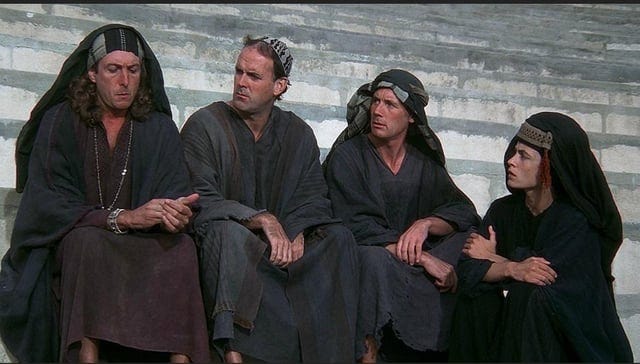
What we’re really seeing is that gender (whatever it is, and the WHO never get around to actually defining it) is not the property of an individual, but the property of how society views that individual. If gender is strongly related to2 how society views you and what society expects of you, then how does self-identifying as a different ‘gender’ change that?
I’ve argued for a while now that the word ‘gender’ causes more harm (to our understanding) than it helps, that it obfuscates rather than clarifies, and that it should be ditched because it brings nothing to the table only confusion. I decided to have another stab because of Kat Highsmith’s excellent article which says the same thing

There’s probably a fair number of things I might disagree with Kat about, but on this issue we find common cause. It’s an important issue that crosses the political divide and it isn’t ‘just’ about a small number of individuals (the old “it’s just a small number so why do you care so much unless you’re a bigot?” line of ‘argument’) it’s about how we structure society and how we protect women and girls from the excesses of men.
Gender, as Kat says, is poison - a toxic unholy mess that we need to scrub away once and for all.
They don’t say what gender is, only what it “refers to”. You could argue that this is just semantics, and maybe it is. Maybe ‘refers to’ here is meant as a synonym for ‘is’, but I don’t think so. It’s meant, I think, to give the reader the implication of a strict definition whilst still being somewhat vague
Those words ‘related to’ again - but in the absence of an actual definition it’s the best I can do
Q: "What’s the difference between one’s gender and one’s gender identity?"
A: The degree of psychosis.
To my very simple mind you have X and Y chromosomes that haven’t the slightest idea what us humans are talking about ; occasionally, and very occasionally, these little buggers may get their wires crossed but in the main they know what they are doing. We have women , those with vaginas, who are more manly and men, those with penises, who are more feminine. The sexual desires of men and woman are predetermined hence why we have lesbians , homosexuals and bisexuals. But you cannot , in any world that I live in, suddenly decide you are a woman if you are a man just by putting on a dress, or even saying you feel like a woman , anymore than you can decide to be a cat. In fact my argument has always been I have literally no idea what it feels like to be a woman, I only know what it feels like to be me; I have no idea if another woman feels being a woman like me. You can have mental health issues that cause you to believe that you are trapped, not in the wrong body, but in a terrible sadness that eats you alive from the inside but has nothing to do with your gender, it’s just the latest tag professionals have found to give to sad , young and impressionable people who in this generation more than any other suffer from and to , God help us all, make them feel better . And many many , I would say most , would benefit from real therapy to deal with their core issues. Again I would argue that it comes from social media and its desire for perfection, loss of sense of belonging whether that be to society, religion, faith or family and the whole trans argument gives this very sad young people something to be a part of , to belong to when they are so lost . We are ignoring the real issues. , I don’t care how you identify , how you want to dress or live your life but we are ignoring the real depression in our youth, we are allowing , disgracefully, doctors to give medication and worse life changing operations, and we are not protecting our young people from these charlatans in the medical profession or young women in safe places which as a mother of a daughter is my prime concern.
I might be wrong but my instinct says I am not, but if I am the very very least I want is for all operations to be banned before a person is 25, at the point at which their bodies and minds are mature. Give them therapy to help their minds from the moment they present to us, not gender therapy , but life and mind therapy, as parents stop using your phones at home, play games , interact , talk to each other , parent, give boundaries , be strict but respectful of their views and feelings , don’t let them always win at sports days, tell them no , our children are overwhelmed , crying out for us to give them boundaries and a safe system they can hold onto . That , in my non medical humble opinion, is what is wrong and what we are all ignoring